


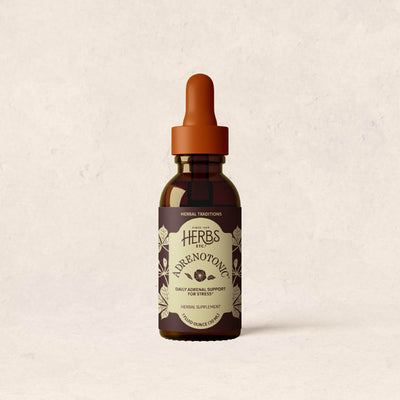
The Tincture Renaissance: A Return to Plant Wisdom

Tinctures are having a moment. You can see it on shelves, in the feeds of wellness brands that didn't carry liquid extracts a year ago, and in the questions retailers are fielding from customers who want to know what that little amber bottle with the dropper actually does.
It's tempting to call this a trend, and in some ways it is. But I think what's actually happening is older and more interesting than that.

What's Actually Returning
Herbal medicine isn't new. It's only in recent American culture that it became fringe. For most of human history, across most cultures, plants were simply part of how people cared for themselves and each other. What feels like a resurgence is really a remembering. People are finding their way back to ancestral traditions and figuring out how those traditions fit into modern life.
What is new is the scale. The herbal products market in the U.S. is growing fast, and with that growth comes opportunity and a certain amount of noise. What's also growing is skepticism. Consumers are getting better at reading labels and asking harder questions, and a lot of what they're finding doesn't hold up. Brands built for algorithms aren't the same as brands built for efficacy, and more people are starting to notice the difference.
I want to be clear about one thing up front: herbs are a tool, not a cure-all. They don't replace allopathic medicine, and anyone telling you otherwise is selling something. The best herbalism I've encountered is nuanced, well-researched, and honest about what plants can and can't do.
How I Got Here
I came to herbal medicine through mental health. I was in community with doulas and midwives, and I remember thinking: if there are herbs that work on reproductive health, surely there are herbs that can support the nervous system too. That question pulled me in, and I haven't left.
Two people shaped my practice more than anyone else. The first is David Winston, whom I moved to New Jersey to study with after taking his class on the differential treatment of anxiety and depression. David is a big proponent of tinctures because they can extract a wide range of phytonutrients, making them more effective. He is also deeply nuanced, both ethnobotanically and scientifically, and I don't think I can overstate how much that modeling mattered to me.
The second is Theresa Richau, who taught me how to tend to the wild without commodifying the plants. I spent time living on Tongva land in Los Angeles, learning about the beneficial role humans can play in native ecosystems. That perspective stays with me. It shapes how I think about sourcing, about harvest, about what it means to be in relationship with a plant rather than simply extracting from it.
I say all of this because I think lineage matters, and I think we don't talk about it enough. Most of us aren't discovering anything. We're carrying forward what our teachers taught us, who carried forward what their teachers taught them. "Creator" culture pushes people to position themselves as experts long before they are, or to gatekeep what they do know. The more honest path is to name who taught you.

So What Is a Tincture, Really?
A tincture is a concentrated liquid extract of a plant or mushroom. The extraction process pulls out both alcohol-soluble and water-soluble phytonutrients, and the alcohol preserves them. The result is shelf-stable, portable, and bioavailable in ways other formats often aren't.
That last part is worth sitting with. Tinctures begin absorbing in the mouth. There's no capsule for your body to break down first. Powders, meaning ground herbs that haven't been extracted, aren't necessarily bioavailable at all. Capsules can contain powdered extracts, which is a different thing than raw powder, but you're still waiting on digestion to do the work.
Tinctures also keep longer than capsules or powders. If you've ever found a jar of something hopeful at the back of your cabinet past its date, you know what I mean.
Why This Format, Why Now
I think people are tired. Tired of fairy-dusted products made more for marketing than for function. Tired of adding another powder to their yogurt. Tired of buying things that expire before they finish them. There are only so many jars you can fit in a cupboard, and frankly, not every herb belongs in your breakfast. Have you ever tasted Andrographis? It is not a smoothie ingredient.
A lot of what's crowding the supplement market right now was built for a feed, not a medicine cabinet. The branding is beautiful, the founders are compelling, and the sourcing is an afterthought. That's not herbalism. That's marketing wearing herbalism's clothes.
What I hope people are moving toward is the opposite of shiny. Tradition. Sourcing. What actually goes into the preparation of what they're putting in their body. Tinctures reward that kind of attention. They ask you to slow down a little, taste something, and notice how your body responds. They're not a hack. They're a practice.

What Herbs, Etc. Has Always Done
Herbs, Etc. has been making tinctures this way for more than five decades. The current attention is new. The approach isn't.
We use the parts of the plant meant to be used, not whatever is easiest to source. We mill the herbs right before tincturing, because once a plant is milled, its compounds start to degrade. We source a significant amount of our material fresh, just-harvested, and extract within 24 hours. Some plants, like fresh Milky Oats, can only be captured this way. Milky Oats are ripe for a short window and lose their activity once dry, so fresh tincturing is genuinely the only way to preserve what they offer. (It's one of the herbs I find most worth highlighting, because it so clearly illustrates why format matters.)
We also believe in formulation. There's nothing wrong with single-herb tinctures, but thoughtful formulas mean the consumer doesn't have to do the formulating themselves. When someone turns to herbal medicine, they've usually already spent time and money trying to feel better. It's our job, as herbalists and as a brand, to make that next step worth their trust.

A Return to Trust
If you're just starting out with tinctures, the mindset I'd suggest is curiosity and a willingness to taste something that might not be delicious. Not everything beneficial is pleasant on the tongue. A Negroni that tasted like Sprite wouldn't be a Negroni.
The larger shift underneath all of this, I think, is about trust. Trust in plants, which have been supporting human health for as long as there have been humans. Trust in lineage, in the people who studied and practiced before us. And trust in your own body, which is more intelligent than wellness culture usually gives it credit for.
That trust is the thing worth returning to. Tinctures are just one of the ways back.
By Blaire Edwards-Maschotta
Sidebar: What is a tincture? A hydroalcoholic liquid extract of a plant or mushroom. Alcohol and water pull out different compounds, and together they capture a broader range of what the plant has to offer. Shelf-stable, portable, and absorbable starting in the mouth.
A small confession: I love tinctures because they're useful in ways that go beyond the stated use. You can take them internally or apply them topically without any additional preparation. And if you have a dog who will not stop begging, a drop of Andrographis on your finger will send them looking for quieter company. Works every time.
Share this

Popular posts


